


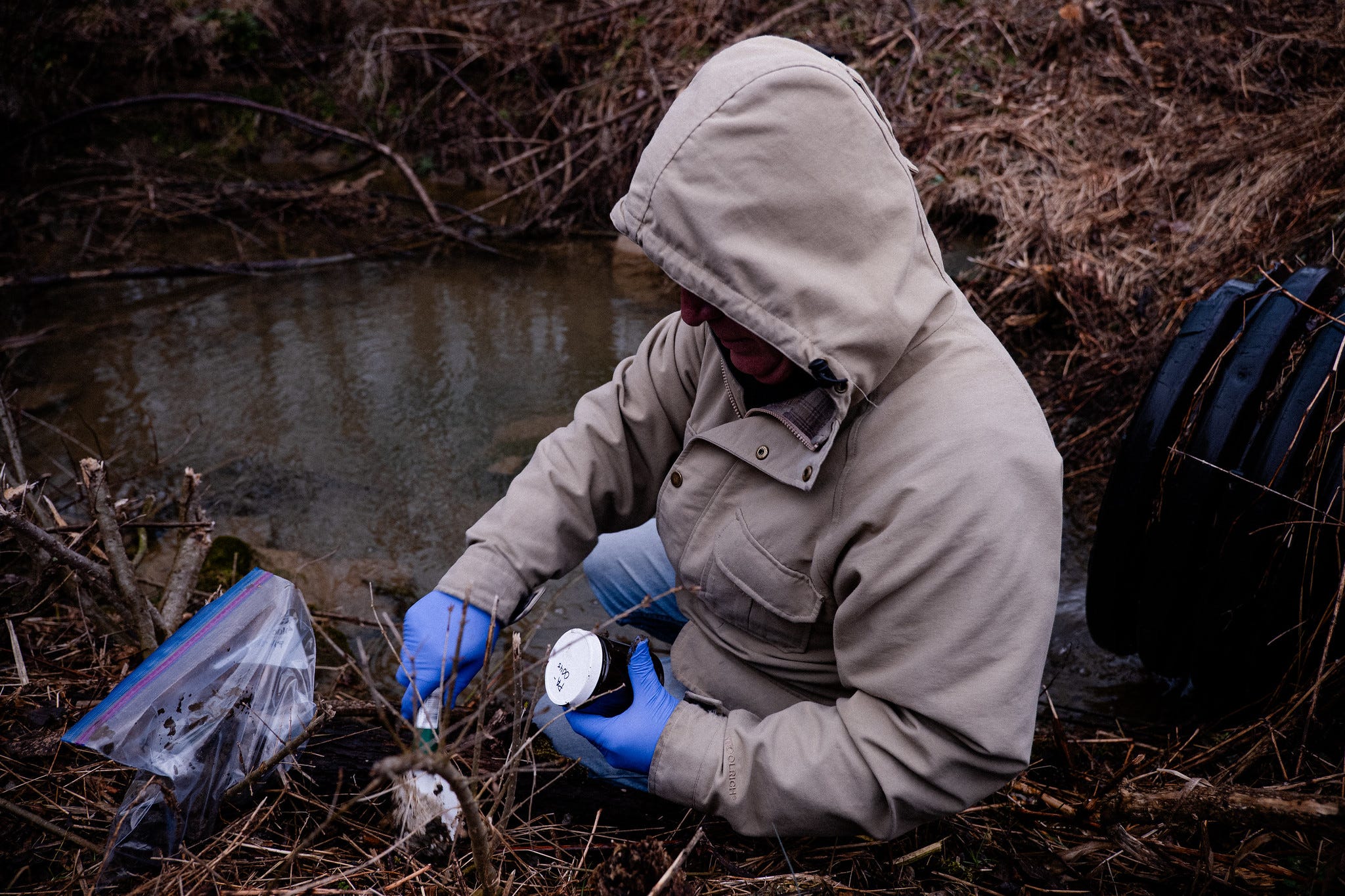
Pennsylvania’s Department of Environmental Protection (DEP) finalized a five-year long investigation on landfill leachate radioactivity in a press release last Friday, declaring “there is no significant risk to human health from radium in landfill leachate.”
DEP Secretary Jessica Shirley added that “the takeaway here is that there is no risk to human health from radiation in landfill leachate.”
When Public Herald took a closer look at their report, we saw DEP’s own findings of detected radium in leachate conflict with that message.
After choosing a benchmark established by the Nuclear Regulatory Commission (NRC) that wasn’t meant to assess risk to human health from radioactivity in landfill leachate, the agency came to bold conclusions. In this case, DEP discretion manufactured what it considered safe, not necessarily establishing, by way of public input or congressional approval, regulations that would best apply for safe discharges of radium to public waterways.
Overall, DEP found all of Pennsylvania’s 49 landfills discharged measurable levels of radioactive leachate. The agency reported radiochemistry results ranging from 1.443 to 122.731 pCi/L, and said 11 of the 49 landfills were above 5 pCi/L, the federal drinking water limit for combined radium-226 and radium-228.
DEP did note that raw landfill leachate is not drinking water, with respect to what’s safe to discharge.

To determine safe levels of radium in discharge, the agency used NRC’s benchmark of 600 pCi/L annual-average limit meant for untreated wastewater coming out of licensed industrial facilities handling radioactive material. DEP’s report stated that because landfill leachate is subject to further treatment, like a sewage facility, before discharge, DEP “can conclude that there is currently no concern” with combined radium in treated discharges to groundwater or surface waters.
This places DEP at odds with a foremost expert on this issue.
In 2019, Public Herald spoke with Duke geochemist Dr. Avner Vengosh who told our team that a sewage authority is “not capable of treating radioactive material in fracking waste,” and that in leachate from fracking waste he would expect “salts, metals, and radioactive elements” none of which would be “retained or removed through conventional wastewater treatment plants.”
The problem is plainly stated by former DEP radiation official David Allard who told Inside Climate News that “There really are no standards for leachate”. In that vacuum, DEP chose the most industry-friendly value available.
DEP Benchmark Could Have Been 3 pCi/L instead of 600 pCi/L for Radium Discharge to Waterways
According to DEP, landfill leachate can be “either treated on-site or sent to a treatment facility before being discharged into a stream or river.” When framed that way, a much lower federal number comes into view.
In 1982, EPA set a 30-day average limit of 3 pCi/L for dissolved radium-226 in certain radioactive mine discharges under the Clean Water Act.
Those limits in 40 CFR Part 440 include a daily maximum of 10 pCi/L for dissolved Ra-226, 30 pCi/L for total Ra-226, and a 30-day average of 3 pCi/L for dissolved Ra-226 and 10 pCi/L for total Ra-226.
Those are not landfill leachate rules, they don’t map perfectly onto DEP’s combined radium dataset, but they do show that there was another choice for assessing the risk to public health. And that when EPA assessed the risk of regulated radioactive industrial discharges to public waters, it used a number 200 hundred times lower than DEP’s 600 pCi/L for what’s considered a safe radioactive benchmark for human health.
If the safe discharge threshold shifts to 3 pCi/L, the number of unique landfills above that line rises to 12.
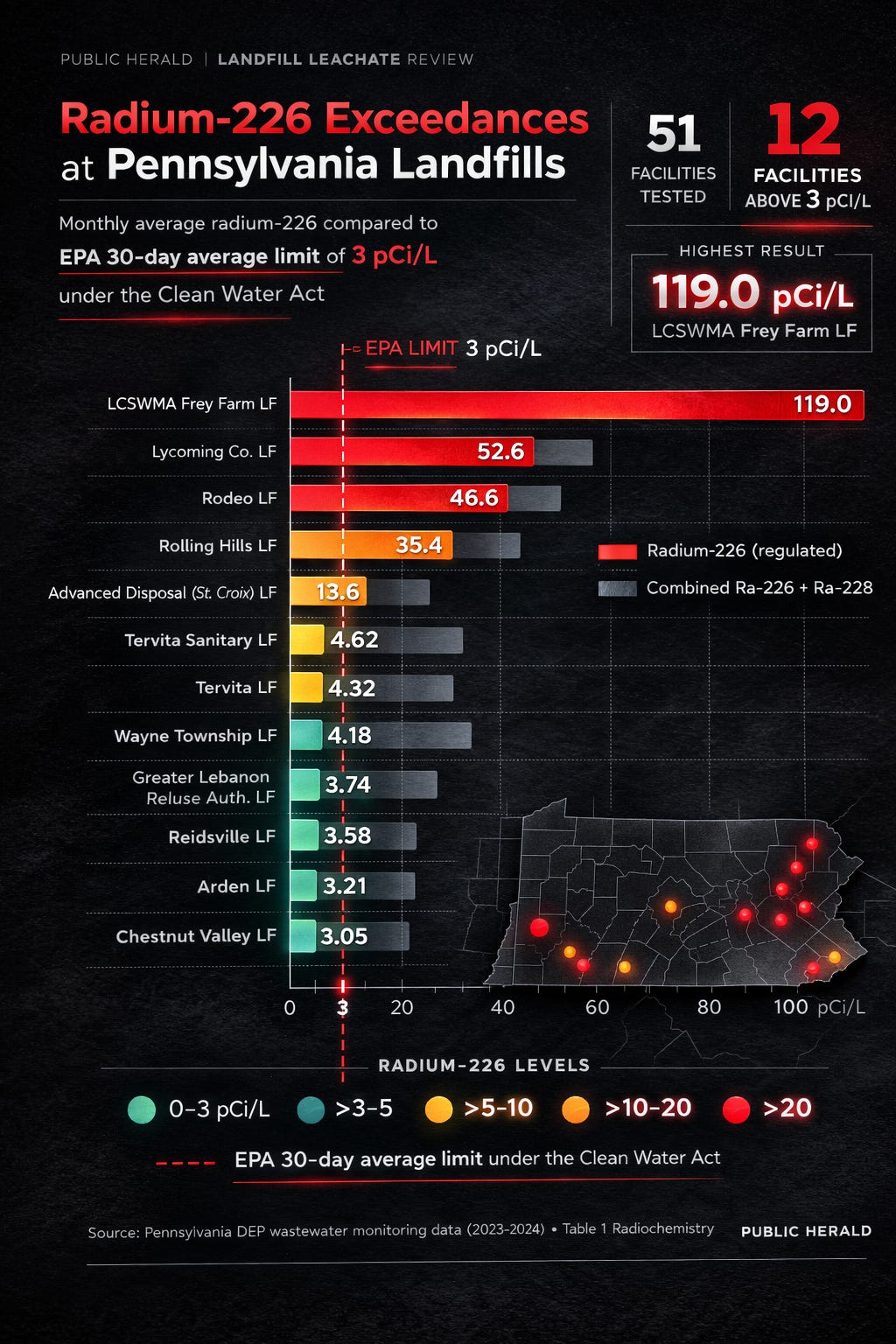
That doesn’t mean the EPA mining rule applies directly to Pennsylvania landfills. It does mean DEP’s “no risk” message depends heavily on which number it chose to emphasize — a number chosen outside of public input. And it shows their hand for how the agency measures risk to human health knowing the massive amounts of radioactive shale gas waste being introduced to landfills in the state.
One question DEP didn’t try to answer is what unmeasured risk is happening to the environment where fish embryos and macroinvertebrates are more sensitive to radioactive material? There’s no indication in the investigation that this question will be tackled in the follow-up to the report.
Seven Years Ago: Public Herald’s Investigation On Radioactive Rivers
In 2019, Public Herald reported that DEP was allowing at least 14 sewage treatment plants to discharge radioactive fracking waste as landfill leachate into 13 Pennsylvania waterways spanning the Chesapeake Bay and Ohio River watersheds. Public Herald also reported that DEP did not have annual leachate volume data for those facilities.
That reporting put the central question in plain view years before DEP released this latest investigation — not just whether radium can be measured in landfill leachate, but where that leachate goes next and what happens when it reaches public water.
The discussion about how much radium a waterway can receive before there’s a radioactive problem takes us back to Vengosh’s earlier warning. During the Seneca Nation’s fight against a proposed fracking waste treatment facility at the headwaters of the Allegheny River, he warned that “one can expect to see a build-up of radiation in river sediment” even if only a small amount of radioactive material remains in the outfall, as long as the discharge volume is large enough.
DEP’s latest investigation unfortunately does not resolve that downstream question, or push for the elimination of radiation in watersheds. It sidesteps it.
In 2019 in Belle Vernon, Public Herald reported one sewage plant discharge sample detected 8 pCi/L of combined radium-226 and radium-228, while leachate straight from the landfill tested at 50 pCi/L (this story is connected to the Tervita Sanitary Landfill).
Plant superintendent Guy Kruppa whistleblowed about the issue, stating he saw trucks coming in during the night carrying oil and gas waste to the landfill said the one-time discharge sample was “without a doubt on the low end”, and that the lower radium reading was “not necessarily a reduction of radium but rather a dilution.”
“Once the effluent is being disposed into the river, the radioactive element will sink or absorb into sediment at the bottom of the river at the disposal site and start to accumulate there,” Vengosh said. His own studies in Pennsylvania found high concentrations of radionuclides in river sediment.
Not only would radium in leachate get into the water untreated in these instances, it can also “kill the bugs” at the sewage treatment plant and force the discharge to release additional contamination to the waterway.
That is a much more realistic claim than DEP’s sweeping message of “no risk.” In Guy Kruppa’s case, he watched the bugs get killed and radium be released and was shocked at DEP’s lack of response during that time.
“We contacted the DEP and told them that we think they are taking frack waste,” Guy told Public Herald in the 2019 report.
“And I told them this thinking I was going to tell them something they didn’t know. And the DEP guy said, ‘yeah, we know.’
“I said ‘you know the landfill is taking frack waste?’ And DEP said, ‘yeah, they’re only allowed to take so much.’ I said do you know how much they’re taking? And DEP said, ‘yeah, they record it on our system.’
“I said do you know they’re taking it at night and on weekends when the landfill is closed. And DEP said, ‘well they’re not allowed.’
“And I said, ‘It might not be allowed, but they’re doing it.’ And DEP said, ‘Well, I don’t know what to tell you.’ And I said, ‘I know what to tell you, they’re taking it!’
“DEP said, ‘it’s on an honesty policy and they’re supposed to report it.’ I told them they’re taking it under the cloak of darkness, long before the landfill opens.
Four Examples Show DEP Gets It Wrong
First, Vengosh told Public Herald that a sewage authority “is not capable of treating radioactive material in fracking waste” and that the salts, metals, and radioactive elements in leachate would not be “retained or removed through conventional wastewater treatment plants.” EPA’s own 2018 CWT study similarly states that “[t]reatment processes at POTWs are not effective at removing all types of pollutants in O&G wastewater.”
Second, the 2016 DEP TENORM study did not show that POTW treatment solved the problem. Citing from language in the study and Public Herald’s coverage, its unfiltered averages for one POTW influenced by oil-and-gas waste were 190 pCi/L Ra-226 and 28.1 pCi/L Ra-228 in influent, versus 103 pCi/L Ra-226 and 10.4 pCi/L Ra-228 in effluent. At another POTW, the unfiltered averages were 103 pCi/L Ra-226 and 11.6 pCi/L Ra-228 in influent, versus 145 pCi/L Ra-226 and 5.00 pCi/L Ra-228 in effluent after treatment. Public Herald summarized the same study by reporting that POTWs accepting oil-and-gas wastewater lowered radium by only 9.3% to 69% on average, that one POTW still discharged 138 pCi/L after treatment, and that at Ridgway the radium level in treated waste nearly doubled on average.
Third, DEP’s own 2016 study did not rule out environmental impacts at leachate treatment sites. In its conclusions, DEP wrote that while there was little potential for direct exposure from sediment-impacted soil at landfills, “there may be a radiological environmental impact to soil from the sediments from landfill leachate treatment facilities that treat leachate from landfills that accept O&G waste for disposal.” Public Herald also quoted that study as finding that “[t]here is a radiological environmental impact to soil from the sediments from POTW-I’s,” meaning POTWs influenced by oil-and-gas waste. And as Vengosh reported the radium will settle to the sediment…so why isn’t the sediment being tested before ruling whether a discharge is safe?
Fourth, later work found exactly the kind of downstream accumulation DEP’s latest press release glides past. The 2023 Ecological Indicators paper found that the effectiveness of effluent management systems “designed for historical landfill waste streams in treating O&G waste is not established,” and that total radium was enriched in sediments downstream of effluent discharges, up to 4x relative to upstream values. Daniel Bain, a research professor at the University of Pittsburgh’s Department of Geology and Environmental Science who studies radioactivity, told Inside Climate News last week that DEP’s new report is “an interim report,” not proof the problem is solved, and warned that regulators are “just acting like the end of the pipe is the end. They aren’t thinking about what’s going to happen as things accumulate in the streams.”
DEP’s Calls For Four More Quarters of Testing
DEP’s report says gamma spectroscopy produced high uncertainty values and high minimum detectable concentrations, limiting the ability to determine true concentrations accurately. The Department noted radiochemistry is more accurate, but acknowledges that only one combined radium data point is available for 47 landfills, with two landfills sampled twice because they had the highest results. DEP then recommends at least four more quarters of radiochemistry sampling.
What DEP doesn’t report is a set of baseline data, so there’s no foundation of radiochemistry at any of the landfill sites before fracking takes place. But that didn’t stop them from stating they don’t believe fracking waste has contributed to radium levels in landfill leachate.
Despite everything Guy Kruppa did to inform the agency — or when facilities like Wayne Township Landfill who accepted drilling waste ended up showing similar radium discharge levels above 3pCi/L as Tervita — DEP is still downplaying the issue.
Bain told Public Herald, “I’ve spent a lot of time trying to find a good baseline. I don’t know that we really have a good baseline, but they’re acting like we do.”
Bain also warned, “There’s discrepancies between what people say they’re sending to the landfill and what people say they receive at the landfill. Those have not been reconciled.” And he cautioned against reading too much into low readings at landfills that have accepted shale waste, “Landfills are designed to drain slowly. Landfills are designed to slow things down. Landfills are designed so the water doesn’t go through [quickly]. We’ve designed landfills to maximize slowness.”
For Bain, this issue requires a lot more than four quarters of testing. Ultimately the radium is there, it’s soluble, and it can travel in leachate.
What DEP Showed, And What It Did Not
DEP’s investigation did show radium in untreated leachate at all 49 landfills. DEP did show 11 landfills above 5 pCi/L. DEP did show none exceeded the borrowed 600 pCi/L comparator.
But DEP did not show a landfill health standard for TENORM in leachate. DEP did not show a pre-fracking baseline for landfill radium or downstream waters. DEP did not show that treatment systems are designed to remove radium in a way that prevents long-term buildup in sediments and waterways. And DEP’s own report says more radiochemistry sampling is warranted.
“Pennsylvania Is The Wild West”
Andrew Gross, a rogue scientist, comes to mind after reading DEP’s conclusions and recommendations to the landfill leachate investigation.

In 2020, Andrew visited Pennsylvania on a drizzly day to collect water, air and soil samples for independent radioactive tests. He told our team:
“Pennsylvania is definitely the wild west when it comes to radiological health regulations. I’ve never seen anything like it. And for me, especially being a guy from Louisiana, that really strikes me as odd, that we’re so much better off down here than all of the people who are so smart up there. Putting this radioactive material into municipal waste sites is a giant concern. That could be life-altering for a lot of people, people in the vicinity, people downwater of streams, all those things.”